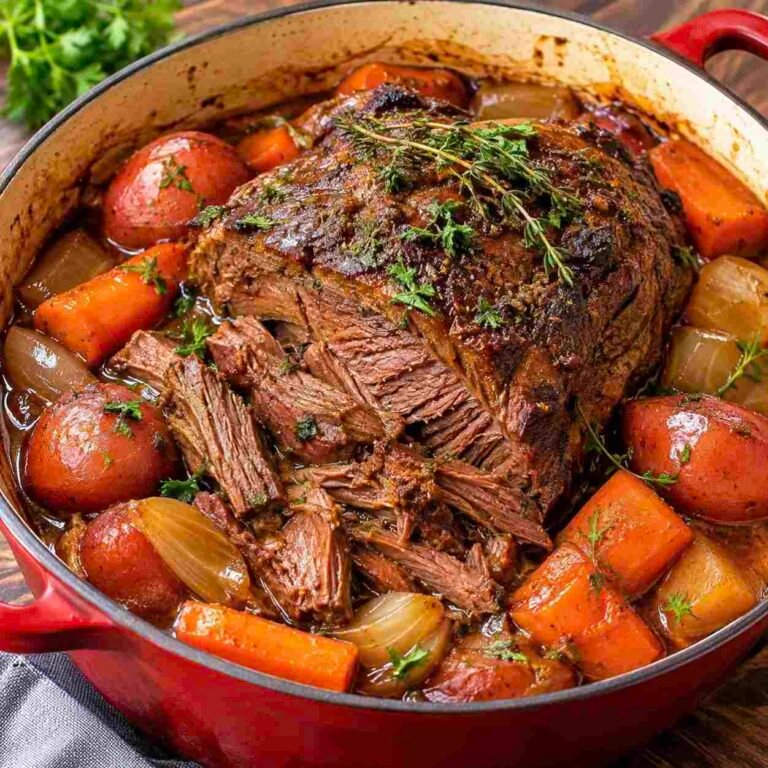

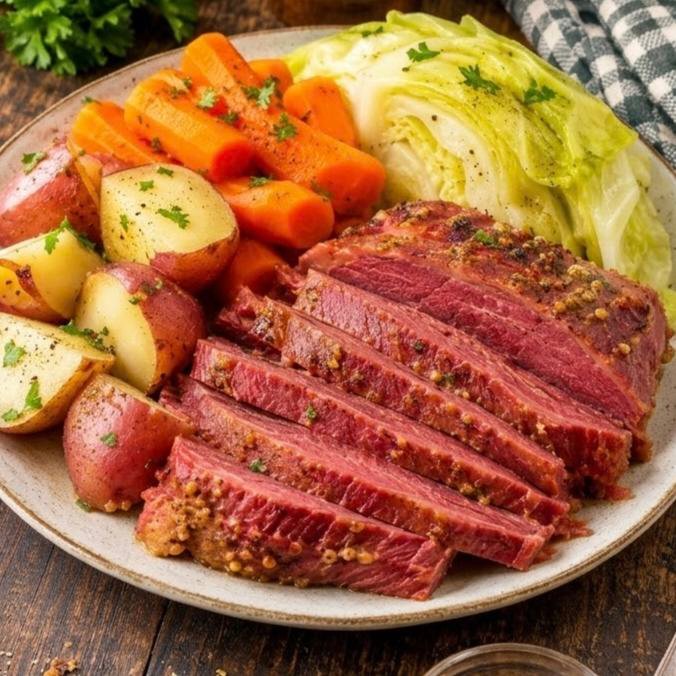
Tender, salty brisket simmered low and slow with cabbage, potatoes, and carrots — a one-pot feast for 6–8 people.
What You’ll Need
Equipment
- Large Dutch oven or heavy-bottomed stockpot (at least 6 quarts)
- Sharp carving knife
- Cutting board with a groove (to catch juices)
- Instant-read or meat thermometer (optional but helpful)
Ingredients (Serves 6–8)
| Item | Amount | Notes |
|---|---|---|
| Corned beef brisket | 3–4 lbs | Flat cut for even slices; point cut for more fat and flavor |
| Spice packet | 1 | The little packet that comes with the brisket |
| Water | 10–12 cups | Enough to cover the meat by 1 inch |
| Guinness or dark beer (optional) | 1 bottle | Adds depth and malty richness |
| Yellow onions | 2, quartered | Or 1 large onion, thick slices |
| Garlic cloves | 4, smashed | |
| Bay leaves | 3 | |
| Whole black peppercorns | 1 tbsp | |
| Whole allspice berries (optional) | 6 | Warm background spice |
| Green cabbage | 1 medium, cut into 6–8 wedges | Core left intact on wedges so they hold together |
| Baby red or Yukon Gold potatoes | 2 lbs, halved if large | Skin on |
| Carrots | 1 lb, peeled, cut into 2-inch chunks | |
| Fresh parsley | Handful, chopped | For finishing |
| Butter | 2 tbsp | For finishing the vegetables |
| Salt | To taste | Go easy — the brine seasons everything |
The Recipe
Step 1: Rinse and Prep the Brisket (5 minutes)
Remove the corned beef from its packaging and rinse it thoroughly under cold water — this washes away excess surface salt from the brine. Pat it dry with paper towels.
Why rinse? Corned beef is cured in a very salty brine. Skipping the rinse can make the finished dish unpleasantly salty.
Step 2: Build the Braising Liquid (5 minutes)
Place the brisket fat-side up in your Dutch oven. Pour in the water (and the Guinness, if using) until the meat is covered by about an inch. Add:
- The spice packet contents
- Quartered onions
- Smashed garlic
- Bay leaves
- Peppercorns and allspice (if using)
Step 3: Simmer Low and Slow (3–4 hours)
Bring the pot to a boil, then immediately reduce the heat to a gentle simmer — you want barely perceptible bubbles, not a rolling boil. A hard boil tightens the muscle fibers and turns the brisket rubbery.
Partially cover with the lid and let it go:
- 3 hours for a 3-lb brisket
- 3½–4 hours for a 4-lb brisket
The brisket is done when it’s fork-tender — a fork should slide in with almost no resistance, and the internal temperature should read around 180–185°F (82–85°C). Unlike steak, corned beef is best cooked well past medium — the collagen needs time to melt into gelatin.
Resist the urge to peek. Every time you lift the lid, you lose heat and extend the cooking time.
Step 4: Rest the Meat (15–20 minutes)
This step separates good corned beef from great corned beef. Using tongs or two large spatulas, transfer the brisket to a cutting board and tent it loosely with foil.
Why rest? Slicing too early lets the juices flood out onto the board, leaving you with dry meat. Resting lets the fibers reabsorb the moisture.
Step 5: Cook the Vegetables (25–30 minutes)
While the meat rests, bring the braising liquid back to a simmer. It’s now a rich, oniony broth seasoned by hours of braising — this is your cooking liquid for the vegetables.
Add the carrots and potatoes first and simmer for 12 minutes. Then add the cabbage wedges, pushing them down into the broth, and cook another 12–15 minutes until all the vegetables are fork-tender.
Timing tip: Cabbage releases sulfur compounds when overcooked, so don’t let it go soft and gray. It’s done when the edges are silky but the core still has a slight bite.
Step 6: Slice Against the Grain
Here’s where most people go wrong. Look closely at the brisket and identify the direction of the muscle fibers — the “grain.” Slice perpendicular to the fibers, about ¼ inch thick.
- With the grain = chewy, stringy slices
- Against the grain = melt-in-your-mouth slices
On a flat-cut brisket, the grain often changes direction partway through — adjust your slicing angle as needed.
Step 7: Finish and Serve
Remove the vegetables with a slotted spoon, toss with butter and chopped parsley, and arrange them around the sliced brisket on a large platter. Ladle a little hot broth over the sliced meat to keep it moist and glistening.
Serving Suggestions
- Mustard: Classic whole-grain or spicy brown mustard on the side is practically mandatory.
- Horseradish sauce: Sour cream + prepared horseradish + splash of broth.
- Bread: Thick slices of buttered soda bread or rye.
- The leftovers (the real prize): Pile leftover slices on rye with Swiss cheese and sauerkraut for a Reuben sandwich, or dice and crisp it up in a skillet with potatoes for corned beef hash with a fried egg on top.
Common Mistakes to Avoid
- Boiling instead of simmering — the #1 cause of tough corned beef.
- Skipping the rest — dry meat, weeping board.
- Slicing with the grain — chewy every time.
- Salting the vegetables — the broth carries plenty.
- Overcooking the cabbage — 15 minutes is plenty; gray cabbage is a tragedy.
Storage & Make-Ahead
- Fridge: Sliced meat keeps 3–4 days in an airtight container with a splash of broth. Vegetables keep 3 days.
- Freezer: The meat freezes beautifully for up to 3 months. Cooked cabbage does not — freeze it only if you must.
- Make-ahead: Corned beef actually slices better after a night in the fridge. Chill the whole piece in its broth, then slice cold and reheat gently in simmering broth for 5–10 minutes.